Author Archives: rose3240

Unknown's avatar

About rose3240

Rose Lucas is a Melbourne poet. Her first collection, Even in the Dark (UWAP 2013) won the Mary Gilmore award; her second, Unexpected Clearing (UWAP) was published in 2016. She is currently completing her third book At the Point of Seeing.

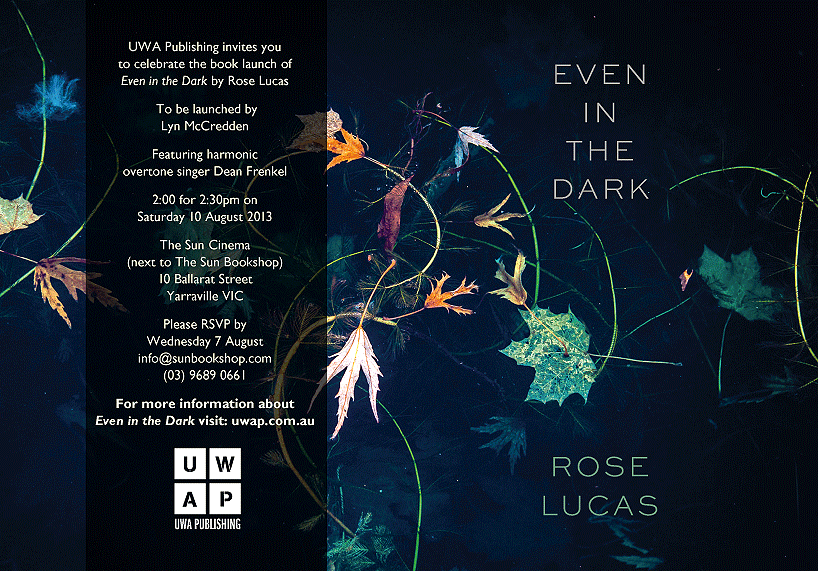
Dean Frenkel to sing at launch of Even in the Dark


Renowned throat/overtone/harmonic singer Dean Frenkel is going to perform at the launch of Even in the Dark. I took a workshop with him several years ago – and though I didn’t learn to throat sing in one session, I was completely captivated by the embodied sound which he produced. And it did lead to the writing of a poem, ‘Harmonic’ – check it out in the Poems section of the blog. I’m excited to be performing alongside him at the launch of my book, on August 10, 2pm at the Sun Theatre Yarraville.

http://www.youtube.com/watch?v=txKBJgQDk8Y&list=TLRExo_H69U6o

Daylesford in Winter

We have just had a great few days at Daylesford – super relaxing and super freezing, especially overnight. On the first day, the mist didn’t lift until midday; other days, it was clear and sunny – until the cold started creeping in again by mid afternoon.

I have always loved the central highlands area. So close to the city but stepping out of its routines, so rich with history yet, for me,  also somehow scoured, simplified. And of course good coffee readily to hand!

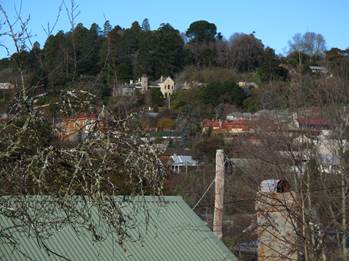
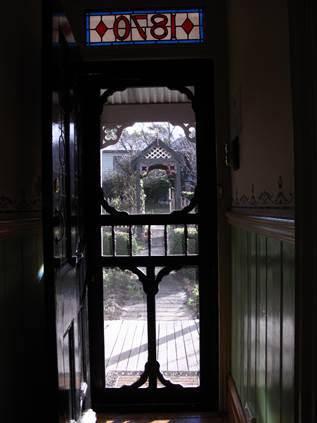
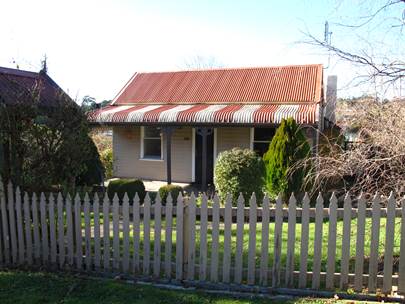
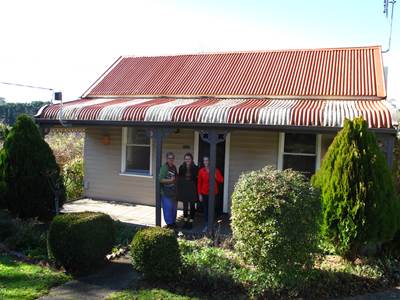
Views of and from our week’s miner’s cottage:

ImageImageImageImage

Another poem (not from the book):

Daylesford Massage

Stranger’s fingers, knuckles, then palms
knead the oiled skin of my back
finding the old knots,
gnarls of muscle and bone and grip
of scar;
my body like a map,
an archaeological dig through histories
of tension, the long lineage of injury,
the genetics of structure,
of hours spent hunched over a desk –
wilting beneath the firm pressure of these working hands
I am transparent,
my right ovary pulses out this month’s lost cargo,
its own fist of tightness,
and in the soft hum of voicelessness
spine and pelvis become visible,
easing into place –

meanwhile my querulous, monkey mind slides to a place
just below the surface of the water –
its swaying reeds, the cool green underside of waterlily leaves –
resting,
like a fish in dappled shallows.

Poetry Interview

I have just done an interview with The Muse: An International Journal of Poetry. It will be online shortly at: http://www.themuse.webs.com/

Thanks to Pradeep!

In the meantime, here is a selection to whet the whistle:

“Even in the Dark is a compilation of poems written over several years. I taught literature at Monash University for 20 years, and poetry analysis and criticism had always been one of my key research and teaching areas. However, I did find it difficult to find the head space to write poetry in the context of academic life; I know some can combine these activities, but for me, it has taken the time and opportunity provided by not being involved in teaching and research that has allowed me to become immersed in the writing of poetry. I also had two important periods where I was attached to Marlboro College, Vermont, USA, as a visiting scholar; these times were crucial for me in terms of finding new life rhythms and a concentration on poetry writing as a craft. I think that standing outside the sphere of one’s familiar or habitual life, can sometimes offer great possibilities for creativity and new perceptions. Even the differences of landscape can operate as triggers for heightened ways of seeing. I think that seeing ‘place’ differently is also a way of seeing ‘self’ differently, and thus shaking up and reconceptualising the vital inter-relationship between the two. Even in the Dark contains poems from this North American experience, as well as poems very specifically centred on Australian landscape and experience, as well as a suite of poems which are more concerned with enlivening moments within the intimate and the domestic.

One of the things that has come to me over a long association with poetry writing and writing about poetry, is that creativity, or a sense of the luminous, often arises out of the experience of the everyday. Moments of the extraordinary can be found within the ordinary;  a heightened awareness can both unravel skeins of possibility from within the quotidian, and, paradoxically, teach us that living is not just about the ‘highs’ of the extraordinary but about  being ‘present’ within the fabric of our daily lives. The business of ordinary living- working, the domestic, children, routines – has become an important source for the writing of my poetry…”

In my experience, art and life are inextricably interconnected. Especially with a genre such as poetry, which works so closely with the personal, I find that the experience of the intimate and the everyday will always closely inform the poetry. It is out of the business of living – of feeling, connecting, risking, sustaining – that the insights or germs of potential poems arise. The poem comes out of the wash of life experience as well as the subliminal, dream-level of response which is always seeking to decode and reframe the componentry of those experiences. Having said that, I am also acutely aware of the labour which is required to transition the experience or the perception into the ‘organic mechanism’ of the poem, if I can describe it like that. The poem is, above all, a communicative device, not just a method of the externalization of the private, and if it is to function adequately as communication, then there is also a very conscious task involved in shaping those responses – images, emotions, even the visceral patterns of blood and breath – into the living form of the poem. I would describe the living poem as one in which individual experience is translated into a form which can evoke similar experiences in a reader – or perhaps at least some embodied experience, given that who really knows the precise contours of another’s response!

.. The natural world is the fundamental basis of human experience. I think this is true even for those of us who live in urban environments. We are still grounded within the sphere of seasons, daylight and darkness, and the world of growing things feeds us in terms of spirit as well as body. To lose track of the natural environment in the course of one’s life, is to lose a vital element of human experience. In this sense, I see poetry’s relationship with the natural world as operating in two ways: first, the natural world is a source of great connection and inspiration. What else do we write about, on one level, except the place in which we find ourselves and our experience of our selves within that specificity? Second, the act of poetry is a way of encouraging and communicating the focused looking which allows us to recognize not just a backdrop to a narcissistic self, but rather a gateway into alterity…

I think there is often a sense that poetry that takes the natural world as one of its primary subject matters is merely trivial, a decorative art that deflects any real understanding of human interiority and interconnection. I suppose some poetry may be like this, but I have always felt that the opportunity to bring one’s attention to the dynamism of the natural world is to find a still point of reflection that will ultimately tell us as much about ourselves as about the specificity of the world.

West Australian Premier’s Book Awards

Literary Prizes: hmmm…

While you might argue that it’s always a strange business ranking literary efforts, prizes are nevertheless great incentives for writers, and they do a fantastic job of getting work out there, noticed and celebrated. So thanks WA Premier’s Department and the SLWA for your ongoing support of the arts!


This year, as for the last two years, I’m chairing the West Australian Premier’s Book Awards, for which I am a Poetry judge. We’ve had some fantastic titles this year – really encouraging to see both established and new poets taking the stage and covering a range of styles and themes. Our recently announced Poetry short list (in alphabetical order) is:

Bonnie Cassidy  Certain Fathoms
Julie Chevalier Darger: his girls
Aidan Coleman Asymmetry
Robert Gray Cumulus
Brook Emery Collusion
Peter Rose Crimson Crop

Stay tuned for the announcement of the winner on September 16th!

Here’s an article from The West Australian regarding the announcement of the short list:
http://au.news.yahoo.com/thewest/entertainment/a/-/arts/17836655/premiers-book-awards-an-exercise-in-vigour/


June 26, 2013

Even in the Dark is taking shape.

Here is the media release from UWAP:

ABOUT THE POET
Rose Lucas is a Melbourne poet, writer and academic and currently teaches poetry and editing at Victoria University, Melbourne. She is the co-author of Bridgings: Readings in Australian Women’s Poetry (Oxford University Press, 1996).
Lucas previously taught in the English department at Monash University for twenty years, and is widely published in the scholarly areas of women’s poetry, feminism, psychoanalysis and literary theory, and cinema studies. She is also currently Chair of the Western Australian Premier’s Book Awards. Her poems have appeared in Heat, Meanjin, Hecate, Best Australian Poems 2007 and 2009, and she was shortlisted for the ABR Poetry Prize in 2009. Even in the Dark is her first collection of poetry.
Media Release
July 2013
Even in the Dark
by Rose Lucas
In this, her first poetry collection, Rose Lucas distills years of writing into an impressive debut.
Even in the Dark contains delicate poems of the lives of women and the exquisite beauty contained in the act of observation.
Evoking luminescent images, Lucas explores nature and beauty, love and travel, in poems set at home and further afield.
The entire lifespan is present here: in vitro to last hours; bodies that develop and then age, captured in whisps of lovely images that can contain danger and risk.
‘These poems are eloquent, graceful and meticulously candid. Their subjects are often local — but Rose Lucas’s major concern is the universal, how life’s balance sheet of wins and losses plays out over changes in time and place. Her control of line patterns, the vigour and clarity of her perceptions, her poise and light-footed music pervade the book in moving ways. There is a questing, vulnerable sensuousness here, yet the overall spirit of her poetry is reverence and joy.’ — Judith Beveridge
UWA Publishing’s poetry list continues to advance the cause of keeping important Australian voices in print as well as new work from contemporary poets, such as Rose Lucas.
UWA Publishing
35 Stirling Highway, Crawley
Western Australia 6009
http://www.uwap.uwa.edu.au
MEDIA ENQUIRIES
INTERVIEWS * EXTRACTS * IMAGES * REVIEW COPIES are available
please contact KIRI FALLS of UWA Publishing
tel: 08 6488 6806 or 0428 136 847
kiri.falls@uwa.edu.au
ISBN 9781742585321 $24.99 pb 128 pages

The launch is now scheduled for saturday august 10, at the Sun Bookshop/Theatre, 2 for 2.30 – so put aside that desire to go to the footy and come along! There will even be entertainment…


Here is another poem from the book, to keep you thinking:


New Born

 Slicked
back with creamy vernix,
you seem to me a
small wet seal,
wrapped tight in your white
cotton blanket.

I hold the bundle of your body
perfect
in my arms –

they were made for this,
they do it without thought
for anything –
            not even my naked,
bleeding body,
or the bustle,
            subsiding,
in the room behind me –

you watch me ,
still;
 together we learn the
words of
touch,
and warmth,
the language of our beating,
            proximate
hearts:

holding,
cleaving,
braiding and
spinning apart like the bright
            ribbons on the maypole,
their cords of rich colour
twisting
in the sun:

Little child,
            complex already,
your crinkled eyes,
   all dark pupils
under these dimmed lights,
fix
on me –
 

Even in the Dark

Two firsts – blog post AND the book.

http://uwap.uwa.edu.au/books-and-authors/book/even-in-the-dark

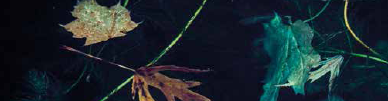
Even in the Dark

the leaves are still

falling – it’s a steady smattering now –
dark on dark they

drop through moony shadows
and into crisp, earth-smelling banks:

[meanwhile, we sleep,
turning like planets in the strangeness of

deep dreaming] –
still, the leaves carpet field, roads

and the quiet floor of the woods;
they fill the lengthening night,

whispering of things fallen
and falling, of what sighs

and subsides, of what bides its time,
breathing slow into the long cold of winter,

all in calm readiness for the onset
of small things –

say, a chink of pale light,
the shift and slip of change.